The ID Validation module determines whether a submitted identity document is authentic. It analyzes the images captured by the ID Capture module against known parameters for the document type, runs a set of authenticity checks, and produces a validation result.
For an overview of this module and how it works, see ID Validation.
Supported with:
✅ Workflows | ✅ Flows
Add ID Validation to Workflows
- In the left menu in Dashboard, click Flow Builder > Workflows.
- Click New or select an existing Workflow.
- Ensure the ID Capture module is in your Workflow.
- Add the ID Validation module. Do one of the following, depending on whether you have the New or Classic view enabled in the toggle in the top right:
- New: After the ID Capture module, click Add node
 > Processes, then search for and select ID Validation.
- Classic: From the Processes list, drag and drop the ID Validation module into the builder after the ID Capture module.
- New: After the ID Capture module, click Add node
- You can click Options
 > Edit on the module node to open the Configuration Options panel and adjust settings as needed.
Add ID Validation to Flows
- In the left menu in Dashboard, click Flow Builder > Flows.
- Click New or select an existing Flow.
- On the Select Modules tab, ensure the ID Capture module is added to the Flow. After you add ID Capture, the ID Validation module becomes available.
- For ID Validation, click Add.
- You can click Details & Configurations to open the Configuration Options panel and adjust settings as needed.
Configuration Options
This section details all the configuration options available for this module. The options that appear depend on whether you have the New or Classic view enabled in the toggle in the top right in your Flow or Workflow. After changing anything, click Save configuration before closing the configuration panel.
The options you see in your configuration may differ from those documented below. Contact your Incode representative for more information.
Configuration Options: New
In New view, the ID Validation module's configuration panel has three tabs that categorize its settings:
- Documents & countries: Choose which document to validate by default, then customize checks for specific countries.
- Fraud prevention: Configure checks that assess whether an ID is genuine and unaltered, including checks for tampering, physical copies and screen-based documents.
- Exceptions: Handle less common captures and special cases.
Some advanced checks must be configured by your Incode representative.
Documents & Countries
| Setting | Description |
|---|---|
| Document to validate | Choose whether the module validates the First ID or Second ID captured. |
| Country-specific validation | Apply different validation checks and thresholds for selected issuing countries instead of using the module’s default configuration. Search for and select the countries you want to add, then click Add selected. Customize the document checks for each ID type for each country. |
Document Checks
| Check | Description |
|---|---|
| Waive expiration check | Do not reject the document because its expiration date has passed. |
| Expiration grace period Workflows only |
Set the number of days after expiration during which the document is still accepted. |
| Minimum age check | Check the date of birth extracted from the document and flag the user if they are younger than the configured minimum age. |
| Type and side cross check | Confirm that the captured images show the expected document type and side, and that the front and back belong to the same kind of document. |
| ID elements tamper check | Detect whether document elements—such as the portrait, text or data fields—have been added, removed, replaced, or moved from their expected positions. |
| Barcode-to-document match | Compare information decoded from the barcode with information visible or extracted elsewhere on the document and flag inconsistencies. |
| ID materials tamper check | Check whether the presented document appears to be made from the expected genuine materials and detect signs of physical tampering. |
| Printed copy detection | Detect whether the user presented a printed copy of an ID instead of the original physical document. |
| Voided ID check | Detect punched holes or other cancellation markings that indicate the document has been voided or invalidated. |
| ID fonts check | Check whether the document’s fonts and typography match those expected for the document template. |
| ID security features check | Check for expected visual security features and template characteristics to identify potentially counterfeit documents. |
| Screen display detection | Detect whether the document was presented on a phone, computer, or other digital screen instead of as the original physical document. |
Fraud Prevention
Info
By default, these settings are configured to Incode's recommendations for successful ID validation. Changing them may introduce too much or too little severity.
To change these settings, click Customize, acknowledge the warning, then click Continue customizing in the dialog. At any time, you can click Reset to Recommended at the top to return to Incode's defaults.
| Setting | Description |
|---|---|
| Duplicate ID detection | Check whether the same identity document has been used in another verification session and flag possible document reuse. |
| Age match: DOB with selfie | Compare the age estimated from the selfie with the age calculated from the document’s date of birth and flag a significant mismatch. |
| Waive expiration check | Do not reject the document because its expiration date has passed. |
| Expiration grace period Workflows only |
Set the number of days after expiration during which the document is still accepted. |
| Minimum age check | Check the date of birth extracted from the document and flag the user if they are younger than the configured minimum age. |
| AI-generated document | If Deepsight is enabled for your organization, and in your Flow or Workflow settings, this setting appears. It detects if the document was generated or manipulated with AI. Configure the severity: Low, Medium, or High. |
Exceptions
| Setting | Description |
|---|---|
| Barcode-only mode | Validate supported documents using decoded barcode data without requiring front or back document images. |
| Type and side cross check | Confirm that each captured image shows the expected document type and side, and that the front and back belong to the same document. |
| Multiple documents check | Detect when more than one identity document appears in a single captured image. |
| Front image age | Check the front image’s metadata for signs that it was created earlier instead of captured during the current session. |
| Front image editing check | Check the front image’s metadata for signs that it was modified using image-editing software. |
| Back image age | Check the back image’s metadata for signs that it was created earlier instead of captured during the current session. |
| Back image editing check | Check the back image’s metadata for signs that it was modified using image-editing software. |
Configuration Options: Classic
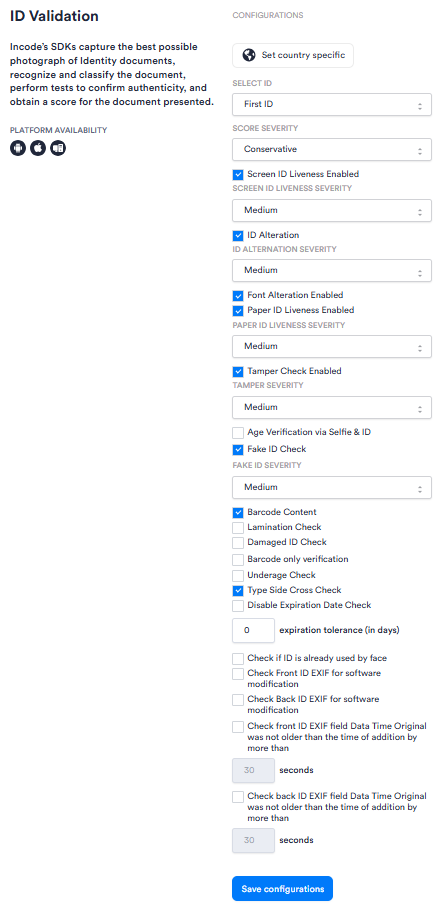
View image of Workflow configuration Panel
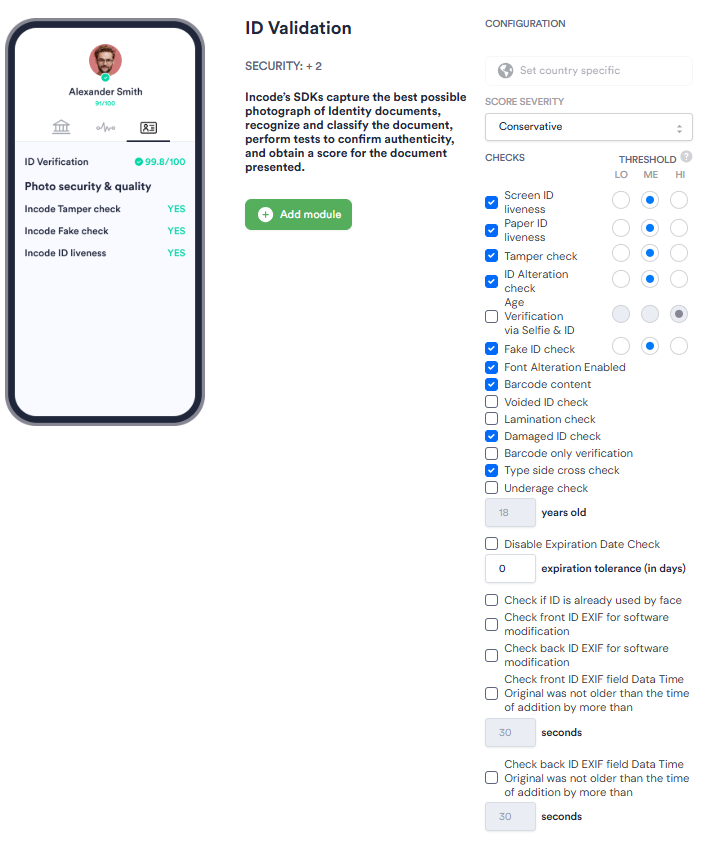
View image of Flow configuration Panel
| Setting | Description |
|---|---|
| Set country specific | Restricts validation to documents issued by a specific country. Enable this when your use case requires country-level document validation. |
| Select ID Workflows only |
Specifies which ID in a multi-ID session this module applies to; for example, First ID or Second ID. Use this when your Workflow captures more than one identity document. |
| Score Severity | Sets the strictness threshold used to evaluate the overall validation score: Soft, Relaxed, Medium, or Conservative. |
| Screen ID Liveness Enabled | When enabled, checks whether the submitted ID was captured from a live physical document rather than a screen or digital display. |
| Screen ID Liveness Severity | Sets the strictness threshold for the Screen ID Liveness check: Low, Medium, or High. In Flows, this is the Threshold radio button. |
| ID Alteration | When enabled, checks whether the ID has been digitally or physically altered. |
| ID Alteration Severity | Sets the strictness threshold for the ID Alteration check: Low, Medium, or High. In Flows, this is the Threshold radio button. |
| Font Alteration Enabled | When enabled, checks for inconsistencies in font rendering that may indicate document tampering. |
| Paper ID Liveness Enabled | When enabled, checks whether the submitted ID is a physical paper or card document rather than a photocopy or printout. |
| Paper ID Liveness Severity | Sets the strictness threshold for the Paper ID Liveness check: Low, Medium, or High. In Flows, this is the Threshold radio button. |
| Tamper Check Enabled | When enabled, checks the document for signs of physical or digital tampering. |
| Tamper Severity | Sets the strictness threshold for the Tamper check: Low, Medium, or High. In Flows, this is the Threshold radio button. |
| Age Verification via Selfie & ID | When enabled, compares the apparent age of the user captured in a selfie against the date of birth on the submitted ID. |
| Fake ID Check | When enabled, checks whether the submitted document matches characteristics of known fake or fraudulent IDs. |
| Fake ID Severity | Sets the strictness threshold for the Fake ID Check: Low, Medium, or High. In Flows, this is the Threshold radio button. |
| Barcode Content | When enabled, reads and validates the barcode on the ID as part of the authenticity check. |
| Voided ID check Flows only |
When enabled, flags IDs that have been canceled. |
| Lamination Check | When enabled, checks for the presence of security lamination on the ID. |
| Damaged ID Check | When enabled, flags IDs that appear physically damaged in a way that may affect validation reliability. |
| Barcode only verification | When enabled, limits validation to barcode data only, skipping other visual checks. |
| Underage Check | When enabled, flags sessions where the date of birth on the submitted ID indicates the user is under the configured age threshold. |
| Type Side Cross Check | When enabled, verifies that the document type indicated on the front of the ID is consistent with data on the back. |
| Disable Expiration Date Check | When enabled, skips validation of the ID's expiration date. Use this to accept expired documents. |
| Expiration tolerance (in days) | The number of days past a document's expiration date that the system still accepts as valid. Default: 0. |
| Check if ID is already used by face | When enabled, checks whether the identity document has previously been submitted in a session associated with a different face. |
| Check Front ID EXIF for software modification | When enabled, inspects EXIF metadata on the front ID image to detect signs that the image was digitally modified using software. |
| Check Back ID EXIF for software modification | When enabled, inspects EXIF metadata on the back ID image to detect signs that the image was digitally modified using software. |
| Check front ID EXIF field Data Time Original was not older than the time of addition by more than | When enabled, validates that the front ID image's EXIF timestamp is within an acceptable window of the time it was submitted. The time window is set in seconds. The default is 30 seconds. |
| Check back ID EXIF field Data Time Original was not older than the time of addition by more than | When enabled, validates that the back ID image's EXIF timestamp is within an acceptable window of the time it was submitted. The time window is set in seconds. The default is 30 seconds. |